India is moving to strengthen its emergency fuel buffer by constructing its largest Strategic Petroleum Reserve (SPR) at Chandikhol in Odisha’s Jajpur district. According to an explainer by StudyIQ IAS, renewed supply risks around the Strait of Hormuz have accelerated the ₹8,571 crore project, which will be developed under a Public-Private Partnership (PPP) model with tender submissions open until February 26, 2027.
Project Scale, PPP Financing, and Underground Rock Caverns
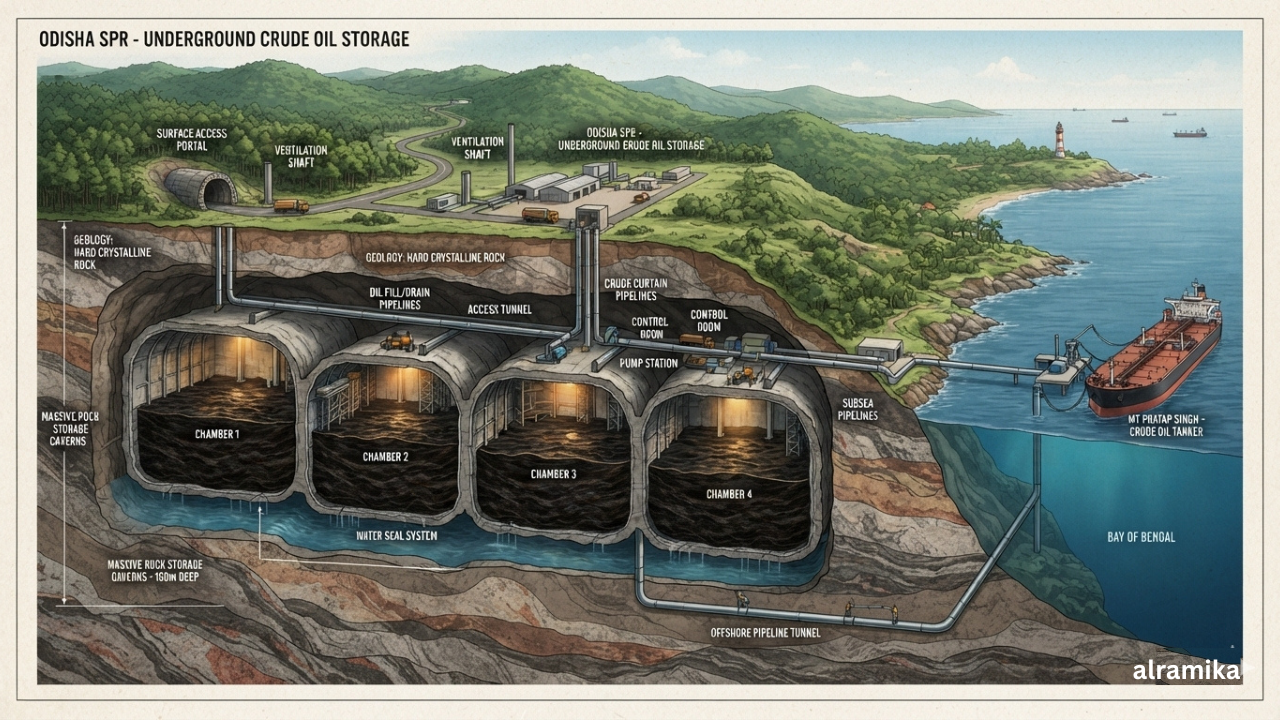
Managed by Indian Strategic Petroleum Reserves Limited (ISPRL), the Chandikhol facility will store 4 million metric tonnes (MMT) of crude oil in underground rock caverns—expanding India’s dedicated strategic reserve capacity by nearly 80 percent.
Unlike India’s three existing reserves—Visakhapatnam (1.33 MMT), Mangaluru (1.5 MMT), and Padur in Karnataka (2.5 MMT)—which were fully state-funded, Chandikhol will follow a Design-Build-Finance-Operate-Transfer (DBFOT) framework. The central government will provide a viability grant of roughly ₹5,142 crore (around 60 percent of the cost), alongside ₹400 crore worth of land, awarding the contract to the qualified bidder seeking the lowest grant.
Why Chandikhol and Underground Storage Were Chosen
Storing crude oil in deep underground rock caverns offers superior fire safety, lower surface land use, and natural temperature stability in geologically stable terrain. Chandikhol also provides major logistical advantages:
- Port and Offshore Access: Crude shipments arriving near Paradip Port will connect to Chandikhol via pipelines, an offshore oil terminal, and a Single Point Mooring (SPM) system.
- Refinery Connectivity: During emergencies, stored crude can be pumped directly to major eastern refineries, including Paradip (Odisha), Haldia (West Bengal), and Barauni (Bihar).
Expanding India’s Emergency Buffer Toward 40 Days
Currently, India holds around 74 days of total oil cover when combining refinery stocks and petrol pump inventories, though dedicated strategic caverns cover only 9 to 10 days of demand—well below the International Energy Agency’s 90-day benchmark.
Once Chandikhol becomes operational, dedicated strategic cover will rise to roughly 16–17 days, with future expansions planned in Padur, Madhya Pradesh (5 MMT), and salt-cavern storage in Bikaner, Rajasthan (5.6 MMT) to reach a 40-day buffer. India is also leasing out 524,000 tonnes of storage capacity at Visakhapatnam to Gulf suppliers like the UAE to generate revenue and ensure ready crude access during global crises.
Related Categories
Explore more Trending story, and World News, on Alramika.