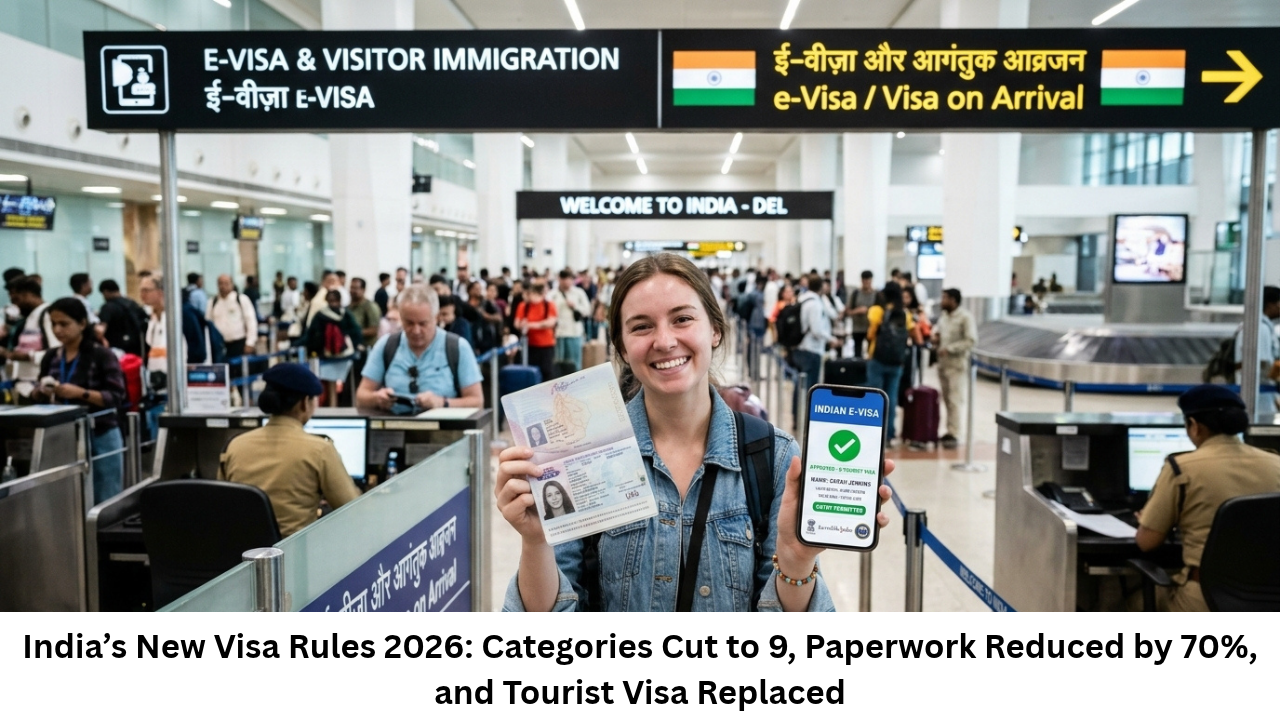
The Indian government has rolled out a major overhaul of its visa administration system to boost tourism, attract foreign investment, and improve the ease of doing business. According to an explainer by StudyIQ IAS, the reforms shrink application forms by up to 70 percent, trim main visa categories from 13 to 9, and consolidate 49 subcategories down to 23—building on an earlier October 2025 update that had reduced categories from 22 to 13.
Nine Core Categories and the New Visitor Visa
The streamlined framework groups entries into nine clear pillars: Business, Diplomatic, Employment, Journalist, Medical, Official, Student, Visitor, and Miscellaneous (covering Persons of Indian Origin and dependents).
In a major shift for travelers, the traditional Tourist Visa has been replaced with a broader Visitor Visa, allowing travelers to combine sightseeing with short-term activities on a single trip:
- V1 Visa: Valid for 30 days with multiple entries, covering tourism alongside business meetings, wellness retreats, medical consultations, and short cultural or music courses.
- V2 Visa: Offers long-term validity of 1, 5, or 10 years, covering all V1 activities plus mountaineering and extended cultural travel.
Upgrades Across Medical, Student, and Business Visas
To strengthen India’s position as a global hub for healthcare, education, and manufacturing, authorities introduced clearer subcategories across key sectors:
- Medical Visas (M1–M4): Divided into M1 for conventional hospital treatments, M2 for medical attendants, M3 for AYUSH therapies like Ayurveda and homeopathy, and M4 for AYUSH attendants—with multiple-entry e-visa options for patients needing repeat follow-ups.
- Student Visas (S1–S2): Split into S1 (up to five years or course duration) for school, undergraduate, and postgraduate students via the Study in India portal, and S2 for PhD scholars, researchers, interns, and visiting faculty.
- Business Visas (B1–B2): Categorized into B1 for long-term ventures and setting up industries, and B2 for short-term technical visits like equipment installation and quality checks.
Expanding E-Visas and Security Oversight
The government is also expanding e-visa facilities—currently available to citizens of 172 countries—to cover production and investment-linked business visits. While these reforms eliminate repetitive paperwork, analysts note that maintaining strong inter-ministerial coordination and updated digital databases across Indian missions abroad remains vital to prevent visa misuse and safeguard national security.
Related Categories
Explore more Trending story, and World News, on Alramika.